

How Much Money Does The City Of Redding Make From All The Recyclables They Pick Up From Ratepayers
Commercial property manager Karen Knorr says her retail tenants are existence blamed for a homeless problem the metropolis of Redding can't control.
For proof, she points to the cardboard recyclable bin backside the Asphalt Shopping Centre on Hartnell Avenue, one of Knorr Management's retail properties in the city.
The city'due south solid waste department took the bin away afterward connected warnings that the cardboard was getting wet and dirty from other trash coming into contact with information technology, all of which renders it worthless to brokers who buy cardboard, drinking glass, plastic and metals from the city and are getting pickier.
In a Speak Your Slice published in the Record Searchlight last weekend, Knorr wrote she is appalled city officials would recall her shopping center tenants would intentionally pollute or trash their own recyclable bins.
Information technology'due south the homeless, who utilize a crowbar or find other ways to circumvent the locked lid and then rummage through the cardboard bin, dump garbage within and go out the lid open afterward they're done.
"Now, on peak of outrageous recycle and pass up fees, we must hire and pay security guards that have to brand sure our Dumpster areas stay clear of transients that the City of Redding has no control over," she added in her open up letter of the alphabet to the metropolis'south solid waste material department.
Knorr manages commercial properties in other cities, including Chico and Sacramento, that are too struggling with how to address the homeless crunch, but she said Redding is the only customs that doesn't want to piece of work with them.
"In this particular instance, it feels like the city is working against u.s., or trying to make the states responsible for an epidemic," Knorr said Monday.
Paul Clemens, the city's deputy managing director of public works who also manages the solid waste section, said he understands Knorr's frustration, but the metropolis also needs to hold its customers accountable.
"In the end, if something is not done, the repercussion tin take huge impacts to our recycling program overall," Clemens said.
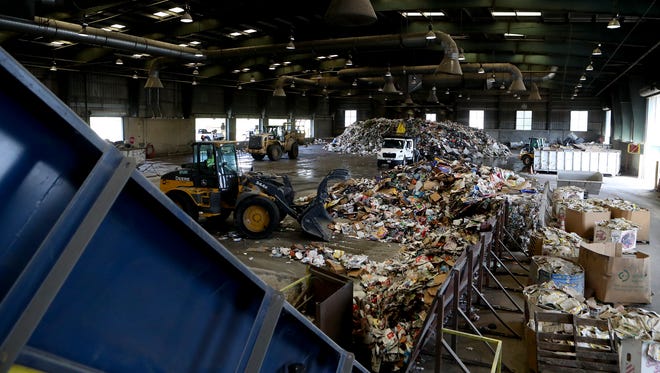
Clemens has no reason to uncertainty Knorr when she says homeless individuals are the culprits, but the city can't hold them answerable, which is why after repeated warnings, the cardboard recyclable bin was taken from Cobblestone.
"I don't know how we would hold them accountable. I think if we answer that question, we could solve a lot of bug," Clemens said.
Clemens said the metropolis is working with Knorr Direction to gear up the problem.
"They understand they tin't dump contaminated material and we understand they tin can't control the homeless population," Clemens said. "We have to find something that is beneficial for both of usa. That is what we're working on."
Clemens, though, doesn't come across a policy shift resulting from the state of affairs at Cobblestone. It might be something every bit unproblematic as changing the type of cardboard recyclable bin at the strip mall.
Tracy Hopper, who works at Knorr Direction and has been in conversations with the city about the shopping center, said the urban center is aware of the outcome, but in her conversations with solid waste employees, she gets the feeling that everybody is at a loss on what to do.
"Information technology's kind of a state of affairs where it's an open-ended problem that nobody knows how to take care of," Hopper said.
While Knorr Management has problems with recyclable bins at its other shopping centers in Redding, Cobblestone Shopping Eye is the worst. Karen Knorr suspects it's because Asphalt backs upwards to the Henderson Open up Infinite, which gets heavy human foot traffic from the homeless.
"Nosotros have homeless from Henderson coming into the center, climbing fences," Knorr said.
A revised anti-camping ordinance that takes effect February. 15 in Redding may change that. The new parks ordinance takes aim at the homeless who camp on public property, such as Henderson Open Space.
And it's non simply the Asphalt Shopping Eye where the bins are hit past homeless and vandals alike.
On Tuesday, a city truck brought in a bin for repair after its locked hat had been pried open up.
"Nosotros keep stacks of lids and lock bars in gild to perform repairs," Clemens said.
Redding has seen an increase in vandalized containers, and not but for the paper-thin but also for trash. City officials attribute the uptick to the homeless population.
"In an attempt to keep individuals from rummaging through containers, many customers have requested locking devices for the containers they utilize," Clemens said. "Often the locking device alone does not deter those who seek to get through the items in the container to find something salvageable or of value to them; whether that be something that may assist with identity theft, recyclables, discarded medication, etc."
Meanwhile, concluding twelvemonth, Redding's solid waste department sold iv,840 tons of cardboard, most 500 tons more than the previous year. Cardboard represents nearly 50 pct of the recyclable tonnage the city sells each year.
The toll the city gets for cardboard has plunged from $200 a ton two years ago to $sixty a ton this yr, Clemens said. The coin the city gets for glass, plastic and metal also has dropped.
"It'due south a commodities market, so it'southward based on demand, and also demand overseas has a lot to do with it," Clemens said.

Likewise affecting the market is Prc, which concluding twelvemonth started being more particular on what recyclable materials information technology will take.
Larger cities tin can blot the costs, just smaller communities like Redding have been harder hit, Clemens said.
Some U.South. counties are charging residents for a let to drop off recyclables at centers, the Chicago Tribune reported. It also said China has lowered its standard for contaminated material to 0.5 percent. The industry standard is between 1 percent and 5 percent.
"It does mean we accept to enforce the policies that we take," Clemens said. "Simply we try to preempt that. We try to talk to people first and then send them a letter because a lot of time that commencement time is unintentional, accidents happen."
When you factor in the toll to selection up and process recyclables against the money it gets for the materials, the city loses money, Clemens said.
Which is why the metropolis must brand sure the cardboard and other recyclables it sells are not contaminated.
Too much contamination will make the commodity harder to sell.
"It tin make it so the textile gets rejected, it can upshot in charge-back costs for freight," Clemens said. "So actually, we're responsible to practise the all-time nosotros can for our ratepayers and get them the all-time bang for their buck too."
More:Volunteers ready to get on the front line of high-stakes homeless count in Shasta County
More than: Redding moves forward with homeless camping crackdown
More:Near ii tons of trash removed along Sacramento River; more cleanups promised
Source: https://www.redding.com/story/news/local/2019/01/30/californias-homeless-crisis-tight-market-recyclables-hitting-home/2702447002/
Posted by: goffrinnaligge.blogspot.com
0 Response to "How Much Money Does The City Of Redding Make From All The Recyclables They Pick Up From Ratepayers"
Post a Comment