

Should You Take A Job For Less Money Than You Want
Always wanted to quit your high-paying chore for a less stressful one?
Ex-BCG Consultant & Thou&A Professional urges caution to those dreaming of pulling the plug on their stress-filled jobs

Proceed with caution! I've attempted to make the movement to a less stressful job twice — with extremely mixed results…
I first left my job as an Acquaintance at The Boston Consulting Group then afterwards left my chore as an Yard&A Professional person at a listed PLC.
I'll quickly run you through what happened during each attempt earlier sharing my thoughts on the pro's and con's and how you can employ these lessons to your own career change.
Attempt #1: Ended terribly…
The first time concluded desperately. I learned that "stress" is divers differently for everyone.
The job I landed in was less stressful on paper — it entailed less of the things that I and nigh others would define as stressful:
· I rarely worked long hours
· I rarely had tight deadlines
· Functioning expectations were far lower than at BCG
But I was far more than "stressed out" at this job!
Why?
At that place was one factor that I hadn't deemed for, and that was my level of motivation to do the work required by my job.
Of course, when I first took the new job this motivation was there. Only soon I realised that the piece of work I was meant to do simply didn't motivate me in whatever way. The massive mental exertion required just to forcefulness myself to practice work that I had no interest in doing sapped all the energy from me. I had really been far happier doing more "stressful", loftier intensity work at my previous job!
The personal stress and unhappiness caused by this lack of motivation outweighed all the other luxuries of my "less stressful" job.
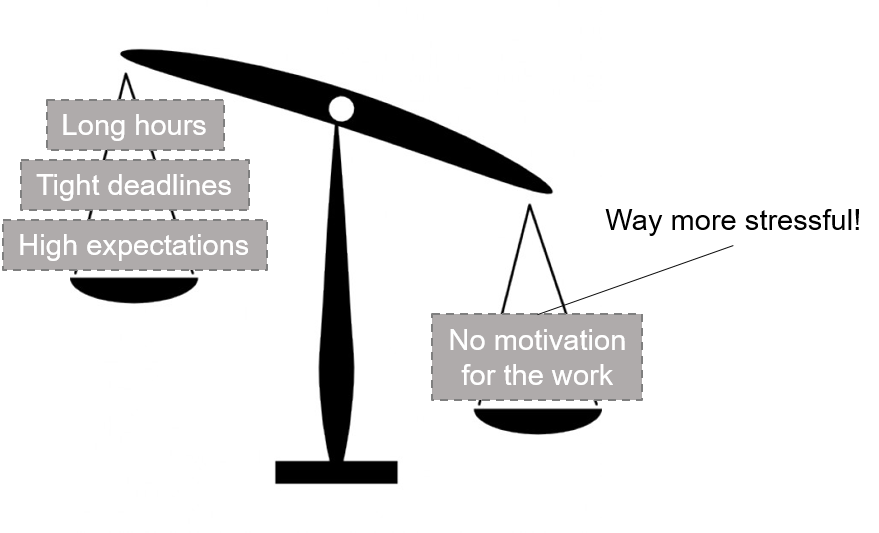
(FYI if you're curious, my motivation to do the piece of work was low for two reasons: ane. The nature of the work didn't intrinsically motivate me ii. I just didn't encounter the point of a lot of the projects I was tasked with (and could never get a satisfactory reason from my superiors)).
Attempt #2: Was terrific!
My second attempt to quit my job for a less stressful one was much more successful!
I had learned the factors I needed to have for a job to be "low stress" for me:
· Autonomy and ability to control my own working hours
· Intrinsically motivated by the nature of the work
· Motivated by the purpose of the work
Then I optimized for these factors in my task search. Doing a task search from first principles like this is challenging — both to find the right opportunities and also to construction them to get the terms you want (remote piece of work / flexible hours / autonomy etc.).
Still, I was disciplined in post-obit a structured process (run into beneath) and my results have been extremely rewarding: since I left M&A I have worked a number of roles that met the to a higher place requirements, where I can paw on heart say I've loved my work while too getting the work-life balance I craved.
The benefits of quitting my high-paying jobs for less stressful lower paying ones
There have been massive benefits to both my professional and personal life:
· I relish my work — of course there are still times when I'd rather do anything else but work, simply long gone are the days of Sunday night fright, wishing my life abroad and counting down the hours until Fri evening
· I'thousand more effective. Working my own hours means the opportunity cost of an extra hour in the role is an hour I could spend outside the office. This forces me to prioritize and be selective about what work I exercise: I work less hours but get more productive piece of work done
· I am energized by my piece of work, and so that when I'yard non working I'm doing fun things that I savour and am agile socially — instead of recovering from the drain of forcing myself to work (or actually working all the time!)
· I no longer experience the need to escape from the stress of work — for years I oasis't had to resort to using alcohol, drugs or Netflix binges to switch off after work and escape the reality of my stress filled life
The costs of quitting my high-paying jobs for less stressful lower paying ones
There are of class costs associated with choosing the "less stressful" route — both financially and personally.
Personal costs:
Most of the personal costs come up upfront, every bit mentally information technology tin can be hard to do the work required to find the right opportunity for y'all.
· Leaving your job: first off yous're going to have to actually leave your current, high-paying, prestigious job. This can exist a bit scary
· Turning down opportunities: secondly — and far scarier — you're going to accept to continually pass up the "wrong" opportunities in your quest for the correct one. There are a lot more stressful jobs out there than non-stressful ones (especially if you use my broader definition of stressful which includes all jobs non personally motivating for you). And the stressful jobs tend to look very appealing from the outside: well paid, prestigious, working with smart people, tried and tested career prospects… While this might not sound all and then appealing now, if you end up leaving your current task to practise a comprehensive job search then resisting these flashy opportunities volition become a whole lot harder a few months into your search!
If y'all want to piece of work a personally low stress job then by definition you cannot stay in or take a job that is non depression stress for you. So you lot merely must forgo all these opportunities.
Financial costs:
Then there is money.
I was both lucky and unlucky financially:
· I was unlucky in that I had to brand large monthly repayments on my $60k of student debt. This meant my savings were basically not-existent and my power to test a lot of depression paying jobs severely limited
· All the same, I was lucky every bit I was in a position where I could literally motility country to one where I could afford to happily live on less money
· I was besides lucky in that I actually found information technology enjoyable to minimize my expenditure — I enjoyed living frugally and making sacrifices for the crusade of paying off my debt and earning myself the liberty to do work I loved and live a life I wanted to alive, on my own terms
Besides, it should be noted that, as I had always suspected, by taking money out of the equation and optimizing for less stressful work that I genuinely enjoyed, I discovered work which I became very good at and ended up earning decent money anyhow!
Everyone's circumstances are dissimilar, but as far as financial costs go I believe that when there's a will there'due south a mode: if you want it badly enough you tin can make it work despite the financial costs.
If I could do it all again…
If yous consider the cost-benefit analysis then this decision is extremely like shooting fish in a barrel. By quitting my high-paying jobs for less stressful lower paying ones I have get mentally stronger and more resilient, more in melody with who I am and what I desire from life and, last but not least, I am more satisfied both personally and professionally.
One final warning
However, I urge you not to blindly rush into this determination. Every bit I promise my story has demonstrated, caution is advised — making a movement to a less stressful job doesn't e'er piece of work out.
Before you make any decision you demand to invest the time preparing and developing a structured exploration process.
If y'all are because quitting your job for a less stressful one then I highly recommend you bank check out my site, The Freedom Series, where you can find some valuable resources on escaping the world of overwork.
Source: https://medium.com/the-ascent/ever-wanted-to-quit-your-high-paying-job-for-a-less-stressful-one-proceed-with-caution-6bfb76a15899
Posted by: goffrinnaligge.blogspot.com
0 Response to "Should You Take A Job For Less Money Than You Want"
Post a Comment